
The phonograph was the very first technique for representing music that was autographic - musical notation and other forms of 'transcription' up until then were decidedly allographic, according the sounds of speech and music to a system of 26 letters and a subsystem of seven notes - from A to G - "thereby categorically excluding all noise sequences" (Kittler 1999: 3). Once a technology can represent sonic singularities, then music is finally freed from the reign of composition/symbolism. Jazz, Rock, Disco, Pop, etc. are not possible without the phonograph.
(But what of oral transmission?)
11.8.09

discourse networks
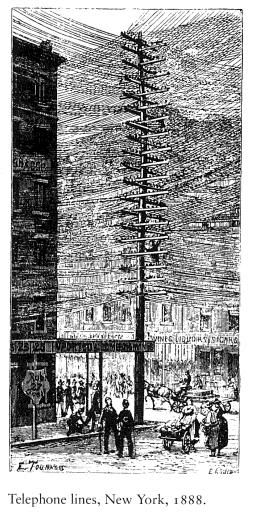
(Gramophone, Film, Typewriter)
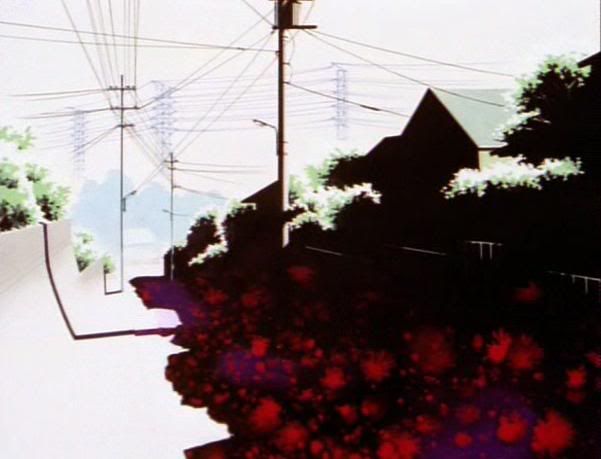
The Wired, Present Day, Present Time
(Serial Experiments Lain)
1.8.09
Communication as a person-to-person activity became thinkable only in the shadow of mediated communication. Mass communication came first ... Miscommunication is the scandal that motivates the very concept of communication in the first place.
(John Durham Peters, Speaking into the Air: A History of the Idea of Communication)
Everybody can give you the proper nightmare, or the proper story of the human subject alienated from the world. Everybody knows how to run that story by. But if you start talking to people about how they cook their dinner or what kind of language you use to describe trouble in a marriage and you’re very likely to get notions of tape loops, communication breakdown - you’re likely to get amazing stuff.
(Donna Haraway in conversation with Hari Kunzru, 1996)
13.4.09
teens
Emmy Hennings, writing on My Disco in Mess+Noise (sorely missed, btw), came up with a turn of phrase that is decidedly Foucauldian and yet insanely applicable to manifold teenage cultural forms:
Every new inscription only serves to create another limit, Foucault might say.
Though when I think about teen films and similar things, there's very much this sense. Transgression as inverted moral teaching.
"Cancer favourites ‘Perfect Protection’ and ‘Measure Wait’ elicit big cheers, and I wonder how a sound so blunt can be pleasurable, and what celebration this largely teenage audience might be finding inside of it. But, moving compulsively to their final song, wanting its artillery tank ferocity to go on forever while simultaneously praying for it to end, I think I understand. This music is both a mirror of discipline and its inversion. In here, the change from one note to the next can promise a space the size of the world."
Every new inscription only serves to create another limit, Foucault might say.
Though when I think about teen films and similar things, there's very much this sense. Transgression as inverted moral teaching.
4.4.09


1.4.09
birthdays as reflexive byproducts of social networks
On a friend's Facebook wall:
"Because of new facebook's ridiculous layout i forgot to wish you a happy birthday!"
27.3.09
■
"When we live in a virtual isolated space, every reconnection with the Real is, of course, something shattering; it is violent." (Žižek, Conversation 4: Tolerance and the Intolerable)
When I visited the tattoo parlour, the guy said to me, "and you know, there's very few things in this world today that you can do that are just for you, for yourself only, and a tattoo is one of them."
When I visited the tattoo parlour, the guy said to me, "and you know, there's very few things in this world today that you can do that are just for you, for yourself only, and a tattoo is one of them."
23.3.09


11.3.09
what's the 21st?
On Silence, by Aldous Huxley
31.1.09
aesthetics and history
Despite a sense of rigur mortis in its theorising, as if it were a static and pervasive phenomenon, the digital aesthetic has a history. Compare the compact disc and the mp3, for instance, both built upon the digital, but carrying very different forms of coding, sound, tactility, look. The fact that sound has 'detoriated' or at least been compressed in the 'advance' of the mp3 is interesting - whereas digital imagery is all about approaching 'reality' or at least something like 'clarity' or relief; more megapixels, sharper flat screen tvs, etc. etc. The disjuncture expressed in the progression of visual versus sonic digitality shows that there is no teleology in this history, but it at least gives rest to pre-digital nostalgia as if herein was petrified.
11.1.09
thrashed
I'd really like to write something substantial one day on the phenonemon of 'thrashing' or 'killing' a particular piece of music, when one has played it so much that you get 'sick' of it. Does this fact mean that such a way of listening is inherently consumerist? Or that all musics (mainly popular music) we find bring on this condition are necessarily or fundamentally consumables?
"Activities of self-realization are subject to increasing marginal utility: They become more enjoyable the more one has already engaged in them. Exactly the opposite is true of consumption. To derive sustained pleasure from consumption, diversity is essential. Diversity, on the other hand, is an obstacle to successful self-realization, as it prevents one from getting into the later and more rewarding stages."
(Jon Elster, philosopher)
Hmmm...
"Activities of self-realization are subject to increasing marginal utility: They become more enjoyable the more one has already engaged in them. Exactly the opposite is true of consumption. To derive sustained pleasure from consumption, diversity is essential. Diversity, on the other hand, is an obstacle to successful self-realization, as it prevents one from getting into the later and more rewarding stages."
(Jon Elster, philosopher)
Hmmm...
25.12.08
what chu waiting for
"Time is for white people"
(Erykah Badu, in Blender magazine, March)
"[T]he idea of modernity as modernization [sic] turns relations of space - relations between cultures - into relations of time, where the white man stands at the pinnacle of world evolution"
(Jonathan Sterne, The Audible Past: Cultural Origins of Sound Reproduction, p9)
This ain't just some bullshit about 'island time'.
(Erykah Badu, in Blender magazine, March)
"[T]he idea of modernity as modernization [sic] turns relations of space - relations between cultures - into relations of time, where the white man stands at the pinnacle of world evolution"
(Jonathan Sterne, The Audible Past: Cultural Origins of Sound Reproduction, p9)
This ain't just some bullshit about 'island time'.
16.12.08
james bidgood
Regarding James Bidgood, federal Australian politician who took photos of a man threatening to set himself alight outside Parliament in protest of his parents' visa troubles. I have little to say on the issue of the photo itself and the ethics of the whole thing, but just find it interesting how the entire event was such a meta kind of media ritual - a ritual about the media within the media.
Says Nick Xenophon, Senator, SA Independent:
"You don't need a code of conduct to tell you whether you're being a jerk or not, and I think there's an enforceable code of conduct in place right now. And that is the media, public scrutiny - if you behave like a jerk you'll get kicked in the public arena, and that's what happened."
That's fascinating enough about what it says about the mediated public sphere and fourth estate etc, but even more interesting is how media is both judge and culprit in this event - able to take differing and even conflicting discursive positions according to how and where the event and its tail of happenings is reported. For the entire reason the photo was taken was because Bidgood has an innate sense of the fact that (news) media space is THE social-political space, in fact one might say he actually helped the protester in this sense. But then are the media culpable? What the fuck is 'the media' anyway?
Says Nick Xenophon, Senator, SA Independent:
"You don't need a code of conduct to tell you whether you're being a jerk or not, and I think there's an enforceable code of conduct in place right now. And that is the media, public scrutiny - if you behave like a jerk you'll get kicked in the public arena, and that's what happened."
That's fascinating enough about what it says about the mediated public sphere and fourth estate etc, but even more interesting is how media is both judge and culprit in this event - able to take differing and even conflicting discursive positions according to how and where the event and its tail of happenings is reported. For the entire reason the photo was taken was because Bidgood has an innate sense of the fact that (news) media space is THE social-political space, in fact one might say he actually helped the protester in this sense. But then are the media culpable? What the fuck is 'the media' anyway?
Subscribe to:
Posts (Atom)